The Portsmouth Nuclear Site (PORTS) at Piketon, Ohio, is the 3,777-acre site where uranium was enriched from the 1950s until 2001. Uranium was first enriched to make nuclear weapons and later for fuel for nuclear power. Enrichment increases the amount of fissionable uranium (U-235) from 0.7% in yellowcake to 3-5% for power and to 95% for weapons. The U.S. Department of Energy (DOE) brought in reprocessed high-level radioactive waste and added it to the enrichment process, contaminating the entire site with radioactive elements such as plutonium, americium, and neptunium, as well as toxins of other types. Depleted uranium (DU) is the waste from uranium enrichment, which is 99% of the original uranium and just as radioactive. PORTS DU is “dirty” because it, too, is contaminated with nuclear waste. PORTS enrichment used as much electricity as New York City according to the former Atomic Energy Commission.
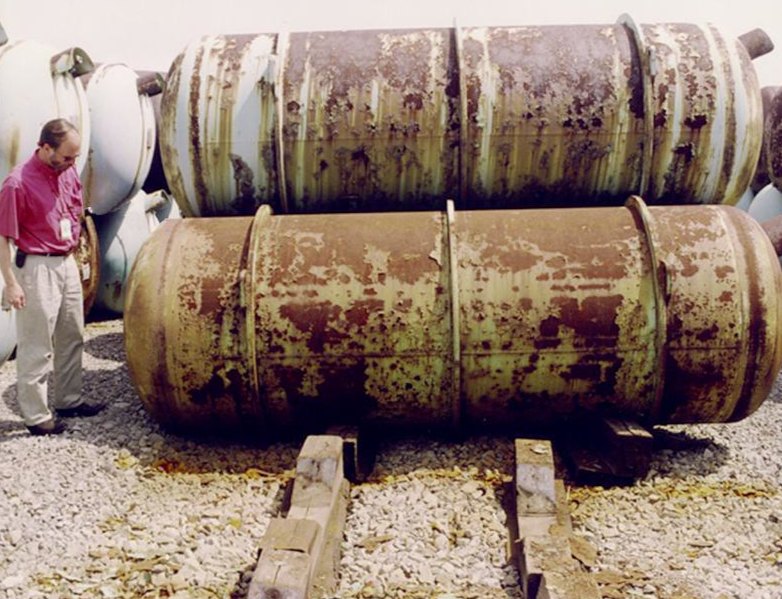
Uranium Conversion: Fluorine is added to uranium in Metropolis, Illinois, creating uranium hexafluoride (UF6), the uranium compound that can be enriched. It is shipped to the Portsmouth Nuclear Site (PORTS) and the Paducah Nuclear Site in Kentucky. The original waste from enrichment is depleted uranium hexafluoride (DUF6). DUF6 is highly chemically reactive. It is eating its way through 19 thousand 14-ton cylinders sitting at PORTS. The conversion process began in 2011. Fluorine is removed from the uranium, leaving depleted uranium (DU) – which has almost all of its radioactivity but no longer reacts with everything around it – an important environmental process. Conversion was stopped in 2015 after two accidents contaminated workers. A new operator, Mid-America Conversion, restarted conversion gradually in 2018.

PORTS WILL SOON MAKE DEPLETED URANIUM FOR THERMONUCLEAR WEAPONS. In January 2020, the Department of Energy (DOE) amended its 2004 Record of Decision (ROD) that had approved the DUF6 process at PORTS. The amended ROD approves a new process not mentioned or analyzed in the original 2004 Environmental Impact Statement. The new process would make purified depleted uranium tetrafluoride (DUF4) for nuclear weapons without doing the required Environmental Impact Statement (EIS).
The Ohio Nuclear Free Network Challenges DUF4: The National Environmental Policy Act indicates that a Supplemental EIS is Required. In February 2020, ONFN attorney Terry Lodge wrote a 16-page letter to DOE stating objections and petitioning DOE for a Supplemental Environmental Impact Statement (SEIS) for DUF4. The letter was signed by 36 organizations. Lodge noted that an adequate SEIS must quantify prospective civilian and soldier victims of DU exposure based upon what is now known about pathways of contamination. Future costs of human decontamination, medical treatment, remediation, and disposal of contaminated infrastructure must be identified. DU dangers to manufacturing workers, transport workers, the American public, combatants, and noncombatants must be assessed. One month later, the DOE responded with a 5-page letter stating no concern with ONFN objections and denying a need for an SEIS. In this letter DOE states that the DUF4 process is for nuclear weapons.
Controversial Health Effects of Depleted Uranium: There is little civilian use for depleted uranium. It is used in armor-piercing shells, gravity bombs, and as protective armor in tanks. Use of these weapons disperses DU in fine particles, including when tanks are hit. Using DU for weapons and armoring of vehicles is highly controversial because of implications for the environment, public and troop health, and international law. Serious health risks occur when this material is ingested or inhaled in war zones, or in test areas such as the former Jefferson Proving Ground in Indiana, which the army claims is too dangerous to clean up. Thousands of tons of DU munitions have been detonated in the former Yugoslavia, Iraq, and Syria. DU weapons are currently being used in Ukraine.
Depleted Uranium is an unknown quantity: It can catch fire spontaneously. Uranium tends to concentrate in specific areas in the body, where the risk of bone, liver, and blood cancers such as leukemia may be increased. Inhaled DU particles may damage lung cells and increase the possibility of lung cancer. Internally, DU may damage the kidneys, the central nervous system, the immune system, or cause reproductive disorders. Since there is a 10- to 30-year lag in development of cancer, effects from DU exposure show up over time. In war areas, children play in DU-contaminated dirt and in shattered tanks where DU has been dispersed. Birth defects in Iraq have greatly increased. DU from PORTS, as explained in the first paragraph, is “dirty,” being contaminated with plutonium and other highly radioactive elements. This greatly and directly worsens the environmental and health impacts.

Gulf War Syndrome: The U.S. has attempted to deny a connection between DU and veterans’ illnesses. Yet years ago the Department of Defense developed regulations and orders requiring military personnel to conduct prompt remediation of personnel and equipment following DU exposures.
International Law and DU Munitions Usage: DU usage falls within a controversial area in international law. The U.N. Human Rights Subcommission on the Prevention of Discrimination and Protection of Minorities passed motions in 1996 and 1997 that urged all states to curb the production and spread of weapons of mass destruction, weapons with indiscriminate effect, and weapons that cause superfluous injury or unnecessary suffering. The list included DU weaponry. The paper concluded that use of DU may breach UN treaties and/or conventions. Serbia has been attempting to sue the NATO nations for DU dropped there in the 1990s.
The new PORTS DU will be for nuclear bombs: Purified DU is needed for “tampers” in nuclear bombs – not for DU munitions and tanks. Tampers allow dialing the magnitude of nuclear explosions up or down. Tampers must have the highly radioactive contamination removed. This is a new process in addition to producing DUF4. These new nuclear bombs present a new escalation in the nuclear arms race.
DOE saves $$: There is a major cost difference between disposing of DU as low-level radioactive waste at a cost of hundreds of millions of dollars, versus selling it to munitions makers. DOE has no plan for purifying the dirty DU used in munitions and tanks so there will be less radioactive contamination when it is used.
The DUF4 process is currently on hold: The cost for Mid-America to build “Line 4” to make DUF4 was discovered to be $58 million – interestingly at a later date. When a contract is over $50 million, DOE is required to put it out for bids. Two other companies then applied for this work. It remains imperative that an SEIS be done for any site.
Another choice? The Pentagon is scrapping 35 million DU rounds because they are becoming increasingly unsafe to use. Disposing of these munitions, including hundreds of thousands of armor-piercing tank shells, is its own challenge. More DUF 4 must be made if there are to be DU munitions in the future. Meanwhile, the military has been thinking about using less-controversial tungsten to replace DU in new munitions.
Every effort must be made to prevent more depleted uranium weapons from entering the world. April 2024 Contact: Pat Marida patmarida@outlook.com

 OHIO NUCLEAR FREE NETWORK
Leave a comment